

I've been spending a lot of time on the pickleball courts over the last year or so, typically playing 4-5 mornings per week.
And it got me thinking...Pickleball and restaurant operations may not seem like they have much in common.
One involves paddles, plastic balls, quick rallies, and a kitchen you are not supposed to stand in.
The other involves food, labor, guests, suppliers, margins, and a kitchen you absolutely need to manage well.
But spend enough time on a pickleball court and a variety of similarities become clear.
Both require quick decisions.
Both reward teamwork.
Both expose weak fundamentals.
Both demand constant adjustment.
Both can be exhausting.
Both can also be a lot of fun when things are working.
And in both, the people who improve are usually not the ones who rely only on natural ability. They are the ones who pay attention, learn from mistakes, communicate clearly, and keep coming back for one more game.
For independent restaurant operators, there are several useful lessons from pickleball that can be applied directly to leadership, service, operations, marketing, and long-term business performance.
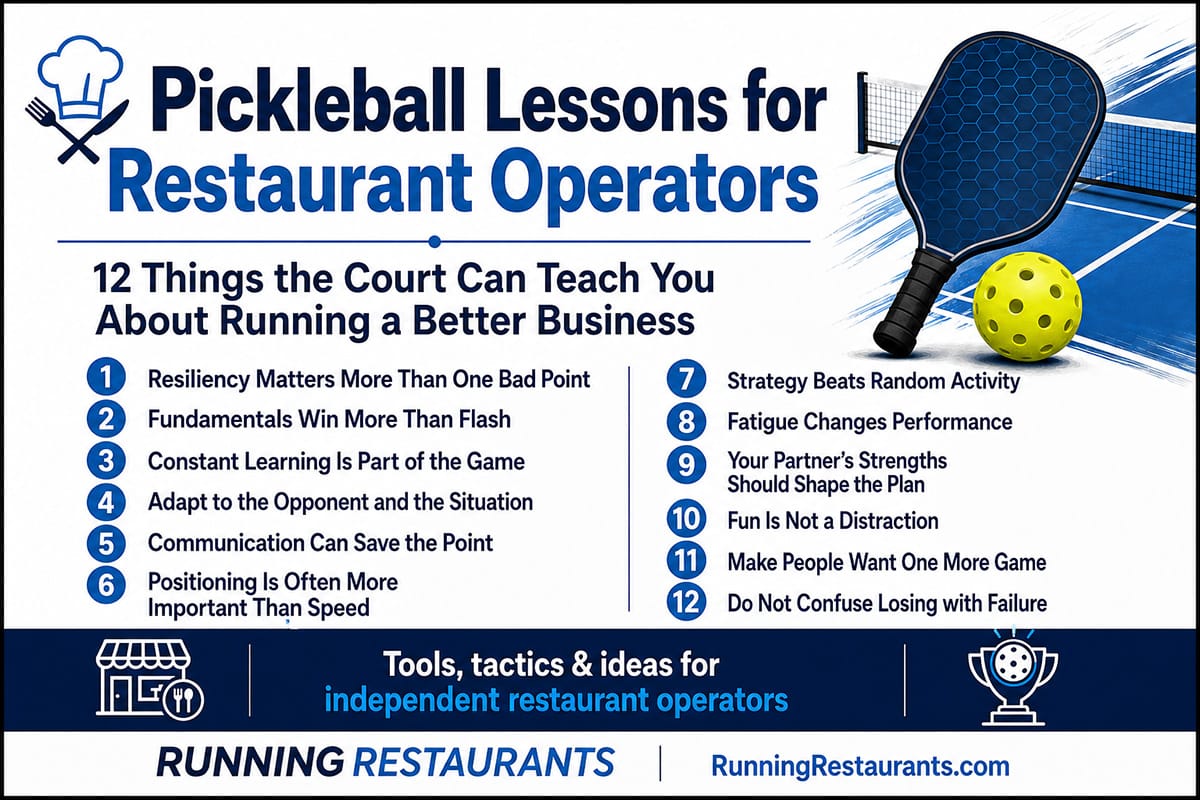
1. Resiliency Matters More Than One Bad Point
In pickleball, one bad shot can cost you a point.
A ball goes into the net.
A return sails long.
You miss an easy put-away.
Your partner moves one way while you move the other.
It happens.
The mistake becomes more damaging when you carry it into the next point.
Restaurant operators face the same challenge.
A bad review comes in. A shift falls apart. A large party is unhappy. A key employee quits. A food delivery is late. A piece of equipment breaks during the rush.
The issue matters, but the reaction matters more.
Strong operators recover quickly. They address the problem, learn from it, and refocus. Weak operators let one setback poison the next shift, the next meeting, or the entire week.
Resiliency does not mean ignoring mistakes. It means refusing to let one mistake become five.
After a rough shift, ask:
- What happened?
- What was within our control?
- What needs to change?
- Who needs coaching?
- What system failed?
- What do we do differently tomorrow?
The lesson from the court is simple: play the next point.
In restaurants, that means solve the problem, reset the team, and move forward.
2. Fundamentals Win More Than Flash
Pickleball players often want to hit the dramatic shot.
They go for the perfect angle. They swing too hard. They try to end the rally immediately. Sometimes it works. Often it creates an unforced error.
The better players understand the value of fundamentals.
Get the serve in.
Return deep.
Move into position.
Keep the ball low.
Be patient.
Wait for the right opportunity.
Restaurants are not very different.
Operators can become distracted by flashy marketing campaigns, expensive remodels, new technology, complicated menus, or the latest industry trend.
Those things may help, but they cannot compensate for weak fundamentals.
The restaurant still needs:
- consistent food
- accurate orders
- clean facilities
- friendly greetings
- reasonable ticket times
- proper scheduling
- portion control
- good training
- strong cash management
- visible leadership
You do not win because of one clever promotion if the guest experience is inconsistent.
You win by doing basic things well, repeatedly.
The restaurant equivalent of keeping the serve in is opening on time, having the station ready, greeting the guest quickly, and delivering what was promised.
That may not feel exciting, but it wins.
3. Constant Learning Is Part of the Game
Pickleball has a fast learning curve at the beginning.
New players quickly learn how to serve, return, score, and stay out of the non-volley zone. But after that, improvement becomes more demanding.
You begin learning:
- shot selection
- positioning
- spin
- patience
- partner movement
- opponent tendencies
- when to attack
- when to reset
- how to handle pace
- how to reduce unforced errors
The same is true in restaurant leadership.
An operator may know food and service well, but the industry keeps changing.
Costs change.
Guest expectations change.
Technology changes.
Labor markets change.
Marketing channels change.
Ordering behavior changes.
Competitors change.
What worked five years ago may be less effective today.
Operators need to keep learning about:
- menu engineering
- labor productivity
- digital marketing
- online ordering
- AI tools
- loyalty programs
- leadership
- cost control
- catering
- guest data
- local search
- new consumer habits
The dangerous operator is not the one who lacks knowledge.
It is the one who believes there is nothing left to learn.
The strongest players and operators stay curious. They watch others. They ask questions. They test new approaches. They accept coaching. They pay attention to results.
Improvement requires humility.
4. Adapt to the Opponent and the Situation
You cannot play every pickleball opponent the same way.
One opponent may hit hard. Another may rely on soft shots. One may struggle with backhands. Another may be highly consistent and wait for you to make the mistake.
Good players notice and adapt.
Restaurant operators need the same awareness.
You cannot run every shift exactly the same way.
A quiet Tuesday lunch requires a different approach from a packed Saturday night. A family crowd behaves differently from a late-night bar crowd. A catering customer has different needs from a dine-in guest. A first-time visitor needs different guidance from a regular.
Marketing also requires adjustment.
One promotion may work well for weekday lunch but fail at dinner. One message may appeal to families but not young professionals. One offer may drive traffic but hurt margins.
The lesson is not to abandon standards. Standards create consistency.
But strategy needs flexibility.
Pay attention to:
- sales by daypart
- menu mix
- guest feedback
- traffic patterns
- weather
- local events
- staffing levels
- customer segments
- promotion performance
- competitor activity
Do not keep hitting the same shot if it is not working.
Adjust.
5. Communication Can Save the Point
In doubles pickleball, poor communication creates immediate problems.
Both players go for the same ball.
Neither player takes responsibility.
One moves forward while the other stays back.
A ball lands between them.
The point may be lost even though either player could have made the shot.
Restaurants lose points the same way.
The host does not tell the server a table has been seated. The server does not tell the manager a guest is unhappy. The kitchen does not communicate that an item is running low. The manager does not explain the shift priority. The closing team assumes someone else completed the task.
The problem is often not effort.
It is communication.
Strong restaurant teams communicate early, clearly, and specifically.
They say:
- "I need help at table 12."
- "We are down to three portions of the special."
- "This guest has been waiting 20 minutes."
- "I'm taking this order. Can you run those drinks?"
- "We have a large party arriving in 10 minutes."
- "That table has an allergy concern."
- "I completed this part of the closing list."
Communication should not happen only when things go wrong.
Pre-shift meetings, clear station assignments, call-outs, manager floor presence, and short post-shift debriefs all improve coordination.
A strong team does not assume everyone knows.
They communicate.
6. Positioning Is Often More Important Than Speed
Pickleball is not just about how fast you move.
It is about where you are.
A player can be quick and athletic but still lose because they are consistently out of position. They stand too far back. They leave the middle open. They fail to move with their partner.
Restaurants have positioning problems too.
Maybe the manager is in the office during the rush. Maybe the host stand is left unsupported. Maybe prep tools are stored far from where they are used. Maybe to-go packaging creates a traffic jam. Maybe the restaurant is spending marketing money on the wrong audience.
Good positioning makes the work easier.
Ask:
- Are managers positioned where guests and staff need them?
- Are stations designed for speed?
- Are your strongest employees scheduled during the highest-pressure periods?
- Are high-margin items positioned well on the menu?
- Is your restaurant positioned clearly in the market?
- Do guests understand why they should choose you?
Running faster does not solve every problem.
Sometimes you need to stand in a better place.
7. Strategy Beats Random Activity
A pickleball player who hits every ball as hard as possible may look aggressive, but that is not the same as being strategic.
Good players build the point.
They move the opponent. They create an opening. They remain patient. They choose the right shot for the situation.
Restaurants need strategy too.
Many operators are busy every day but still lack a clear direction.
They post randomly on social media. They run promotions without measuring results. They add menu items without reviewing profitability. They purchase technology without defining the problem. They schedule based on habit instead of sales.
Activity is not strategy.
Strategy means deciding:
- who your best customers are
- what you want to be known for
- which sales channels matter most
- which menu items deserve attention
- which dayparts need growth
- which metrics should be monitored
- where the restaurant has a real competitive advantage
It also means saying no.
You do not have to chase every trend, promotion, platform, or idea.
The best move is not always the hardest shot. It is the one that improves your position.
8. Fatigue Changes Performance
Pickleball can feel easy at first.
Then fatigue sets in, footwork slows, patience fades, decisions get worse, and easy shots become harder. Players start reaching instead of moving. They swing too aggressively because they want to end the rally.
Restaurant fatigue works the same way.
Long hours and constant pressure affect judgment.
Tired managers become reactive. Tired cooks make mistakes. Tired servers lose patience. Tired owners avoid important decisions or communicate poorly.
Burnout is not just a personal wellness issue.
It is an operational risk.
Operators should pay attention to:
- chronic understaffing
- excessive overtime
- managers working without recovery time
- employees skipping breaks
- schedules that ignore workload patterns
- owners who never step away
- frustration that becomes normalized
Sometimes the answer is not to push harder.
It is to improve scheduling, simplify the menu, cross-train the team, delegate more effectively, or eliminate unnecessary tasks.
You cannot expect peak performance from an exhausted team forever.
Rest and recovery are part of performance.
9. Your Partner's Strengths Should Shape the Plan
Good doubles teams do not pretend both players are identical.
One partner may have a stronger forehand. Another may be better at the net. One may be more consistent. Another may be more aggressive.
Strong teams understand those differences and use them.
Restaurant managers should do the same.
Not every employee needs to be great at everything.
One server may be excellent with first-time guests. Another may be a strong salesperson. One cook may be highly organized. Another may stay calm during volume. One manager may be strong with numbers. Another may be excellent at coaching.
The goal is to improve everyone, but also to build around strengths.
Ask:
- Who is best at training new hires?
- Who handles difficult guests well?
- Who communicates clearly during the rush?
- Who is good at suggestive selling?
- Who notices operational details?
- Who helps stabilize the team?
Put people in positions where their strengths matter.
A team becomes stronger when people know their roles and trust each other to perform them.
10. Fun Is Not a Distraction
People keep playing pickleball because it is fun.
Yes, they want to improve. Yes, they want to win. But the enjoyment matters.
That is a lesson restaurant operators should not dismiss.
Restaurants are demanding workplaces. The standards need to be high. Accountability matters. Performance matters.
But a workplace without any energy, laughter, recognition, or enjoyment becomes difficult to sustain.
Fun does not mean lowering standards.
It can mean:
- celebrating a strong shift
- recognizing a team win
- running a friendly sales contest
- sharing guest compliments
- creating team traditions
- acknowledging birthdays or milestones
- using humor appropriately
- making pre-shift more engaging
- thanking people sincerely
People are more likely to stay in a place where they feel connected.
A strong culture should be productive and enjoyable.
Those two things are not opposites.
11. Make People Want One More Game
One of the most recognizable parts of pickleball is the phrase:
"One more game."
Players may be tired. They may have already played longer than planned. But they still want another round.
Why?
Because the experience is engaging. There is always another chance to win, improve, compete, connect, or have fun.
Restaurants should ask a similar question:
What makes guests want one more visit?
A restaurant does not grow only by attracting first-time guests. It grows by creating repeat behavior.
Guests come back because of:
- consistent food
- warm service
- favorite menu items
- recognition
- convenience
- atmosphere
- value
- new experiences
- loyalty rewards
- special events
- emotional connection
Operators need to create a next reason to return.
That might be:
- a bounce-back offer
- an upcoming event
- a seasonal menu item
- a loyalty reward
- a great farewell
- an email invitation
- a limited-time special
- a personal connection with the staff
The goal is not just to complete the current transaction.
The goal is to create anticipation for the next one.
12. Do Not Confuse Losing with Failure
Every pickleball player loses games.
Sometimes you play well and still lose. Sometimes you are outplayed. Sometimes the ball takes a strange bounce. Sometimes the other team simply executes better.
Business works the same way.
Not every promotion will succeed. Not every hire will work out. Not every new menu item will sell. Not every technology investment will deliver. Not every guest will be satisfied.
Failure is not trying something that does not work.
Failure is refusing to learn from it.
The better question is:
- What did the result teach us?
- Was the idea bad or was the execution weak?
- Did we measure the right thing?
- Should we adjust, continue, or stop?
- What would we do differently next time?
Operators who are afraid to lose become afraid to test.
And restaurants that stop testing eventually stop improving.
Final Thought
Pickleball teaches many of the same lessons that show up in strong restaurant operations.
Recover quickly after mistakes.
Build on fundamentals.
Keep learning.
Adapt to the situation.
Communicate with your partner.
Improve your positioning.
Use strategy instead of random effort.
Manage fatigue.
Build around strengths.
Keep the experience fun.
Give people a reason to come back for one more game.
Running a restaurant is harder than playing pickleball, of course.
The stakes are higher. The pressure is greater. The financial consequences are real.
But the underlying principles still apply.
Success does not come from winning every point.
It comes from staying in the game, learning from each rally, supporting the people beside you, and becoming a little better every time you step onto the court.
Or into the restaurant.


