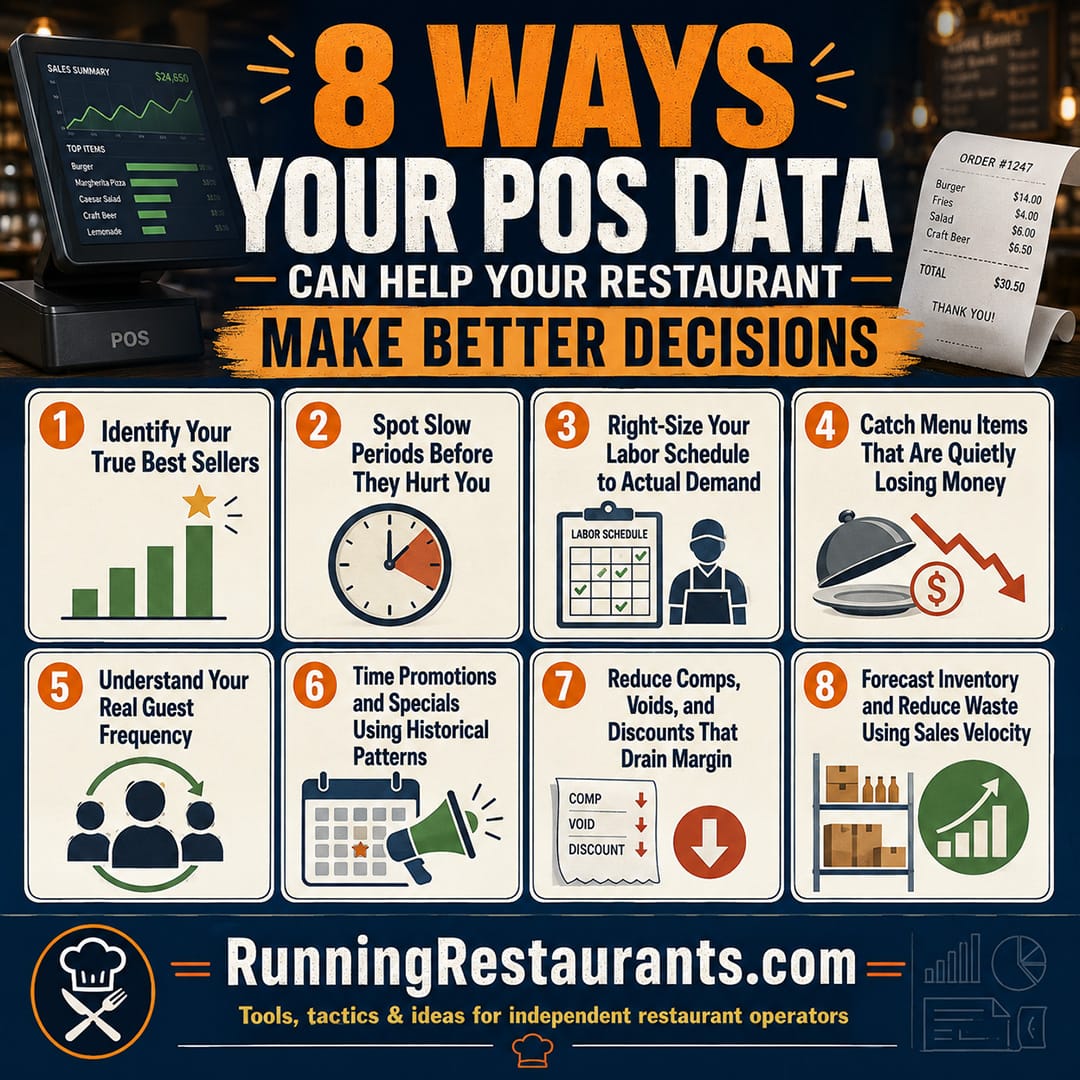
Most independent restaurant operators are sitting on a goldmine of decision-making data in their POS system. The fix isn't a new system. It's a new habit: pulling three or four reports you already have access to, on a schedule, and using them to make better decisions.
Below are eight practical ways to turn your POS into a decision-making tool.
1. Identify Your True Best Sellers (Not Just the Popular Ones)
Popularity and profitability are not the same thing. Run a menu mix report that shows unit sales next to item-level food cost, and you'll often find your "signature dish" is a margin drain while a side item nobody talks about is your real profit engine.
Do this: Pull a 90-day sales-by-item report, sort by contribution margin (price minus food cost), not by units sold. Flag anything in your top 10 for popularity that falls in your bottom half for margin. Those items need a price adjustment, a portion adjustment, or a menu redesign to nudge guests elsewhere.
2. Spot Slow Periods Before They Hurt You
Your POS logs every transaction with a timestamp. That means you have an exact, hour-by-hour map of when guests actually show up, not when you assume they do.
Do this: Pull sales by hour and day of week for the last 60 to 90 days. Look for the dead zones (often 2 to 4pm or Tuesday evenings) and decide deliberately: close that window, run a targeted promotion, or reduce staffing. Guessing here either wastes labor dollars or loses sales you didn't know you were missing.
3. Right-Size Your Labor Schedule to Actual Demand
Labor is usually the second-largest cost after food, and most schedules are built from habit rather than data. Your POS sales-by-hour data, layered against your labor report, tells you exactly when you're overstaffed and when you're dangerously thin.
Do this: Calculate labor cost as a percentage of sales for each hour block, not just for the whole day. Any hour running above your target percentage (commonly 25 to 35 percent depending on service style) is a candidate for a schedule cut. Any hour running well below target with guests waiting is a candidate for an add.
4. Catch Menu Items That Are Quietly Losing Money
Food costs move constantly: a produce price spike, a new supplier, a recipe drifting from spec. An item that was profitable in January can be underwater by June, and nobody notices until the P&L looks off.
Do this: Run item-level food cost against current supplier pricing quarterly, not annually. Any item where actual cost has crept within 5 points of your target food cost percentage needs a menu price update, a recipe review, or a portion check immediately.
5. Understand Your Real Guest Frequency
Most operators believe they know their regulars. Your POS, especially if you use loyalty tracking, often tells a different story about who's actually coming back and how often.
Do this: Pull repeat-visit data over a 6-month window. Segment guests into first-time, occasional (2 to 3 visits), and regular (4-plus visits). If your regular segment is shrinking, that's an earlier warning sign than a sales dip, and it points you toward a guest retention problem rather than a marketing-reach problem.
6. Time Promotions and Specials Using Historical Patterns
Too many specials get scheduled based on what's in the walk-in or what sounds good, not on when guests are actually likely to respond. Your historical sales data tells you exactly which days and dayparts need a push and which don't.
Do this: Match your slow-period data (from Tip 2) against your promotion calendar. If you're running your Tuesday special on a night that's already your third-busiest, you're wasting the discount. Redirect promotions to your genuinely weak windows instead.
7. Reduce Comps, Voids, and Discounts That Are Quietly Draining Margin
Comps and voids are sometimes legitimate service recovery, and sometimes a symptom of employee theft, kitchen errors, or manager overrides that have become habitual. Your POS tracks every one of them, by employee and by reason code, if you're using them.
Do this: Pull a comp/void report by employee monthly. Look for outliers: one server or bartender with a comp rate double the team average is worth a direct conversation. Require a reason code on every discount over a set dollar threshold, and review that list weekly, not quarterly.
8. Forecast Inventory and Reduce Waste Using Sales Velocity
Ordering by gut feel leads to two expensive mistakes: running out of a top seller on a busy Friday, or over-ordering a slow mover that spoils before it sells. Your POS sales velocity data (units sold per day, per item) is a far more reliable ordering guide than last week's memory.
Do this: Build a simple par-level sheet using average daily sales per item over the last 4 weeks, adjusted for known upcoming events. Update it monthly. This alone typically cuts waste and stockouts more than any single vendor negotiation.
Operator Takeaways
- Pull a menu mix report sorted by margin, not popularity, and flag your bottom performers
- Map sales by hour and day to find dead zones worth cutting or promoting into
- Calculate labor percentage by hour block, not just by day, to right-size shifts
- Recheck item-level food costs quarterly against current supplier pricing
- Track repeat-visit frequency to catch retention problems before sales drop
- Align promotions to your actual slow periods, not your assumed ones
- Review comp and void reports by employee monthly, with reason codes required
- Set par levels from real sales velocity data, updated monthly
Next Step
Pick one report from this list you've never pulled before and run it this week. You don't need new software or a data analyst. You need thirty minutes and the willingness to let the numbers challenge your instincts.