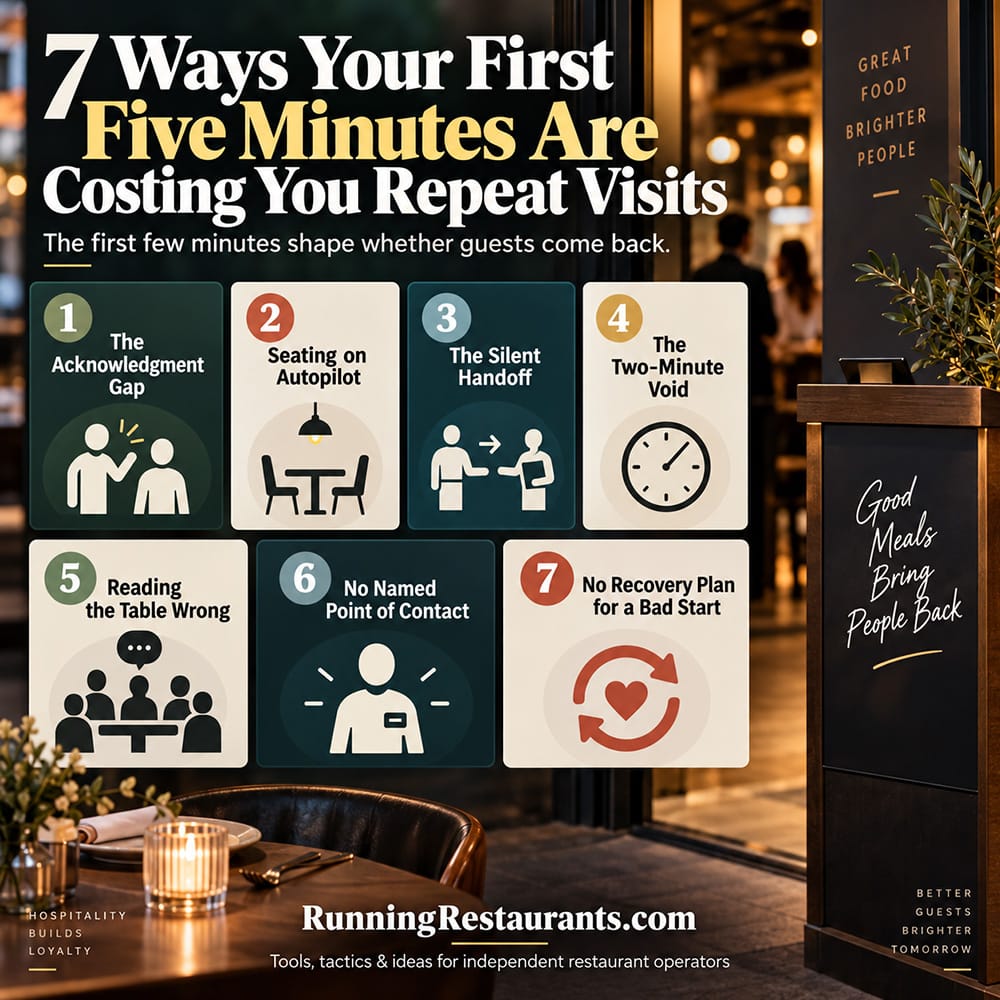
A guest decides whether they're coming back long before the food hits the table. It happens in the door, at the host stand, and in the first minute or two of being seated. By the time the first course arrives, the guest has already formed a working opinion of your restaurant: rushed or unhurried, cared-for or ignored, worth a special occasion or just a place to eat. Food can improve that opinion slightly. It rarely reverses it.
The first five minutes are a system. And like any system, if nobody owns it, it tends to slip. None of this shows up on a P&L line, but it shows up in your repeat-visit rate, and eventually in your reviews.
Below are seven places operators commonly leak repeat business in those first five minutes, with the fix for each.
1. The Acknowledgment Gap
A guest walks in and no one looks up for eight, ten, fifteen seconds. In that silence, the guest is already recalibrating expectations downward.
The fix isn't "greet warmly." It's a hard rule: every guest gets eye contact and a verbal acknowledgment within ten seconds of crossing the threshold, even if it's just "Hey, be right with you" from across the room. Ten seconds is short enough to build into a checklist and long enough that staff can actually hit it consistently. Put a chime or door sensor on the entrance if your host stand doesn't have a clean sightline. Nobody should be surprised by a guest.
2. Seating on Autopilot
Hosts under pressure default to whatever table is fastest to fill, not whatever table fits the guest. A couple on a date gets seated next to the server station. A family with a stroller gets a two-top wedged in a corner. It's efficient for the host and quietly annoying for the guest.
Train hosts to ask one question before walking anyone to a table: "Anything I should know, celebrating something, need extra space?" That single question changes the seating decision more often than operators expect, and it signals the restaurant is paying attention to who's actually in front of them, not just filling seats.
3. The Silent Handoff
The host walks the guest to the table, drops menus, and disappears without a word about who's serving them or when someone's coming. The guest sits there unsure whether they've been forgotten.
Fix this with a scripted bridge: "Sarah will be right with you." That single sentence tells the guest two things: a specific person is responsible for them, and someone is coming soon. It costs nothing and closes a real anxiety gap.
4. The Two-Minute Void
This is the single biggest first-five-minutes problem in full-service restaurants: guests sit down and wait far too long before anyone from the server team makes contact, even just to acknowledge them and take a drink order.
Set a house standard: table contact within two minutes of being seated, water or drink acknowledgment within that same window. This doesn't mean rushing the greeting. It means someone shows up, even briefly, so the table knows they haven't been lost in the shuffle. Track it. A manager doing a walk of the floor every fifteen minutes, noting any table sitting untouched past two minutes, will find this problem fast.
5. Reading the Table Wrong
A scripted, upbeat greeting lands fine for a birthday party and badly for a couple having a quiet, tense conversation, or a solo diner who wants to be left alone with a book. Staff who deliver the exact same energy to every table aren't being consistent, they're being tone-deaf.
Coach servers on table-reading as a real skill. Body language, noise level, what's on the table already, whether phones are out. The greeting should match the table, not override it. This takes practice and real-time coaching on the floor, not a laminated script.
6. No Named Point of Contact
Guests who never learn their server's name, or whose server never learns theirs, have a transactional experience by default. That's fine for a quick counter-service lunch. It's a missed opportunity everywhere else, especially for regulars you're trying to build into repeat guests.
Servers should introduce themselves by name in the first exchange, and for tables that give a name back (reservations, loyalty members, regulars), use it once naturally within the first few minutes. Not repeatedly, not performatively. Once, naturally. That's the difference between "recognized" and "working a script."
7. No Recovery Plan for a Bad Start
Reservations get lost. Tables run long. A guest's first five minutes go sideways sometimes no matter how tight your system is. What separates restaurants that keep guests anyway is whether there's a visible recovery move.
Give hosts and managers standing authority to fix small first-impression failures on the spot: an apology that names the specific problem, a manager stopping by the table within the first few minutes if something went wrong at the door, a small gesture if the wait ran long. The goal isn't to comp everything. It's to make sure a rough start doesn't compound into a guest who quietly decides not to come back and never tells you why.
Building the System
None of this requires new headcount or new technology. It requires a standard, a way to check the standard is being met, and a manager willing to walk the floor with a stopwatch in their head instead of just their eyes on the kitchen. Pick two of these seven, set the standard this week, and have a manager track compliance for ten shifts before adding a third.
Operator Takeaways
- Every guest gets acknowledged within 10 seconds of walking in, verbally or with eye contact.
- Hosts ask one question before seating: is there anything they should know about this table.
- The host-to-server handoff always includes the server's name, spoken to the guest.
- Table contact happens within 2 minutes of being seated, no exceptions.
- Greeting energy matches the table's mood, not a fixed script.
- Servers introduce themselves by name and use the guest's name once, naturally, if they have it.
- Managers have standing authority to recover a rough start on the spot, without needing approval.
- Track compliance on 2-3 standards at a time before adding more. Systems that aren't measured tend to drift back to old habits within a few weeks.