Labor costs are up, food costs are up, and traffic in most markets is flat or down. You can't always control covers walking through the door. You can control what happens once they're seated.
A team that adds even $4 to $6 to the average check through better suggestion, timing, and language (without a single guest feeling sold to) can move the needle on margin more than almost any other single lever available to an independent operator this year.
The restaurants that consistently post higher average checks aren't the ones with the most aggressive staff. They're the ones whose staff understand hospitality-driven selling and suggestions that feel like genuine care.
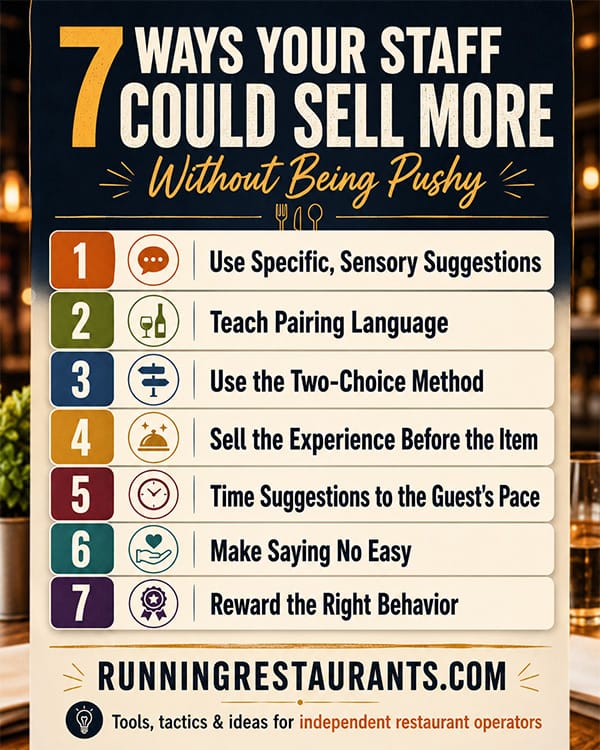
Here are seven tips for your restaurant team...
1. Replace "Would You Like Fries With That?" With Specific, Sensory Suggestions
Generic add-on questions ("anything else?", "want an appetizer?") get generic answers: no. Specific, sensory language gets yes. Compare:
- Weak: "Do you want to start with an appetizer?"
- Strong: "The short rib empanadas just came out of the fryer. They're a table favorite before the mains arrive."
Operator action: Give every server three "go-to" sensory descriptions for your highest-margin items and drill them in pre-shift. Specificity reads as expertise, not as a pitch.
2. Teach Pairing Language, Not Upsell Language
"Would you like to add a glass of wine?" sounds transactional. "This dish is actually built for a crisp Sauvignon Blanc, want me to bring one out?" sounds like guidance. The difference is framing the suggestion around the guest's dish, not your revenue.
Operator action: Build a one-page pairing cheat sheet (entrée paired with wine, beer, or a non-alcoholic option) and require every new hire to memorize it during onboarding, not just bartenders.
3. Use the Two-Choice Method Instead of Open Questions
Open-ended questions invite "no." Choice-based questions invite a decision.
- Instead of: "Would you like dessert?"
- Try: "We've got a warm chocolate lava cake and a key lime pie tonight, should I bring menus, or do you already know which one's calling your name?"
This isn't a trick. It's simply easier for a satisfied guest to pick between two appealing things than to evaluate whether they want "more."
Operator action: Rewrite your dessert and bar-add-on scripts around two named options, never a yes/no prompt.
4. Sell the Experience Before the Item
Guests don't resist good food. They resist being sold to. Reframe suggestions around the occasion at the table. A server who notices a birthday, anniversary, or celebration and says "since you're celebrating, can I bring a round of our sparkling flight to toast with?" is enhancing the moment, not padding the check.
Operator action: Train hosts and servers to flag celebration cues (reservation notes, verbal mentions, decorations brought in) and hand off that information at the pass. Don't rely on memory alone.
5. Time the Suggestion to the Guest's Pace, Not Your Ticket Times
The most common pushy moment isn't the suggestion itself. It's the timing. Suggesting dessert while guests are still finishing entrées, or pitching a bottle of wine before they've even opened the menu, reads as sales pressure regardless of the words used.
Operator action: Build timing checkpoints into service standards: appetizer suggestion within 90 seconds of greeting, dessert/coffee suggestion only after plates are cleared and the table's pace has visibly slowed.
6. Make Saying No Easy and Consequence-Free
Counterintuitively, the servers who sell the most are often the ones guests trust to take no for an answer gracefully. A server who responds to "just the check, thanks" with a warm "Of course, I'll grab that now" (instead of a second pitch) builds the trust that makes the next suggestion land. Guests say yes more often to people who don't need them to.
Operator action: Coach servers explicitly: one suggestion per course, one graceful acceptance of "no," full stop. Micromanaging every guest interaction for a second attempt is where "helpful" tips into "pushy."
7. Recognize and Reward the Right Behavior, Not Just the Number
If the only thing you track is average check size, you'll eventually get the aggressive behavior you were trying to avoid. Instead, recognize specific behaviors: a server who used a sensory description, made a pairing suggestion, or personalized a recommendation based on what the guest actually said. Behavior-based recognition shapes the habit; number-only incentives shape the shortcut.
Operator action: In pre-shift or weekly meetings, spotlight one specific example of a server doing this well. Not just "Maria had the highest check average," but "Maria noticed the table mentioned they were celebrating and suggested the sparkling flight toast. That's the move."
Operator Takeaways
- Replace open-ended add-on questions with two named, specific choices.
- Build a one-page pairing cheat sheet and require it in onboarding.
- Set timing checkpoints for suggestions tied to service pace, not ticket pressure.
- Train staff to flag celebrations and special occasions at the pass.
- Coach one suggestion per course, then a graceful, no-pressure acceptance of "no."
- Recognize specific selling behaviors in pre-shift meetings, not just check totals.
- Audit your own scripts: if a line could appear in a fast-food drive-thru, rewrite it.
Next Step
Pick one of these seven tactics and roll it out at your next pre-shift meeting. Don't try to install all seven at once. Practice the sensory-description or two-choice method with your team for two weeks, track the average check change, and build from there.